 ResumeFinch
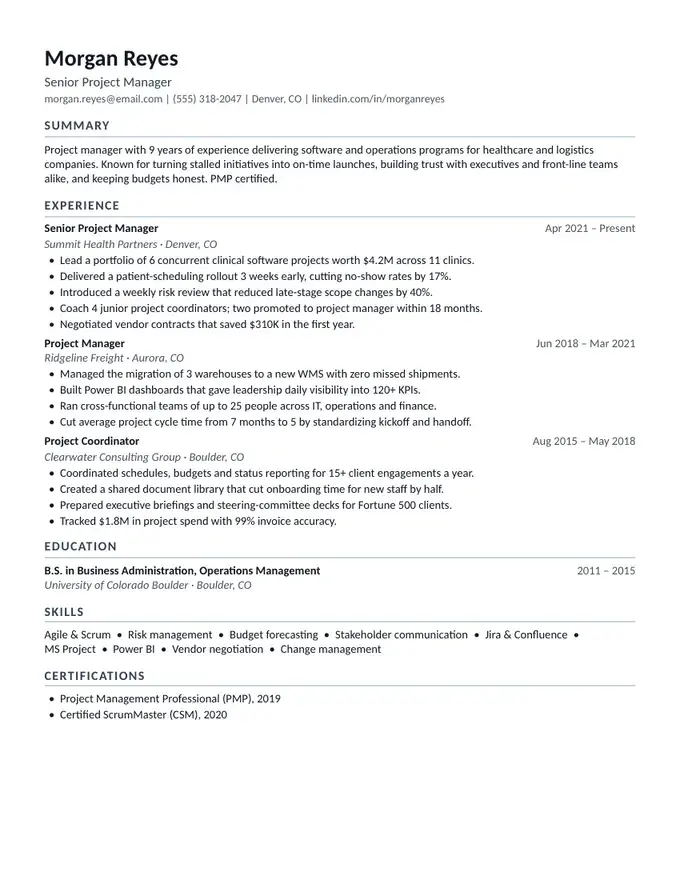
Slate resume template
Simple and compact
College students
A college student resume template puts education at the top, then fills one page with part-time jobs, class projects and campus leadership. The skill is choosing which of those to show, and that changes a lot between your first year and your last.
This page covers the general student resume you keep current for campus jobs, part-time work, scholarships and research positions. Applying for an internship specifically? The internship resume template page shows how to tailor one to a single posting. Already graduated with little work history? The no-experience resume template is written for that.
Free to build and preview. Downloads are a one-time payment, no subscription.
The sample belongs to Aaliyah Brennan, a fictional third-year marketing major. Her page shows the pattern most students can copy: an education entry with GPA and four courses, two part-time jobs written as real work, three projects with a named class or purpose, and two leadership roles with dates. Numbers in the sample are placeholders.
Notice what is missing. There is no objective, no list of soft skills like 'hardworking', no high school, and no 'References available upon request'. Each of those takes a line that a project or a job bullet could use better.
A first-year resume and a senior resume use the same template but carry very different material. Use the row for where you are now.
| Year | What fills the page | What to cut or add |
|---|---|---|
| First year | College and intended major, any job you held before or during college, one or two activities you have joined | Keep high school only for a strong honor or a job tied to the role; it goes once you have a semester of college material |
| Second year | Declared major, first college GPA, a campus job, a class project with a result, a club role | Replace pre-college entries with college ones; add a Projects section if you have two or more |
| Third year | Upper-level coursework, a research or internship role, a leadership title, specific technical skills | Trim first-year activities you have dropped; this is the version most internship applications draw on |
| Senior year | Capstone or thesis, internships, the strongest leadership role, measurable results | Cut coursework to the most relevant three or four; prepare to move Experience above Education after graduation |
| Returning or part-time adult student | Current degree and expected date, plus your full-time work history | If your work history is the stronger evidence, put Experience first and keep Education directly below it |
Projects show what you can do with a skill; leadership shows how you work with people. Each line should name the context (the class, club or purpose), what you did and what came of it. Here is how one of the sample's project lines was built from a first draft.
Personal projects count too. A dashboard you built from your own data, a small website or a podcast you edit is evidence of skill when it is described with the tool you used and what it does.
For leadership, the title matters less than the action. 'Member, Marketing Association' says little. 'Organized a networking night with 3 local agencies' says you can plan, invite and follow through.
If your projects are more relevant to the job than your work history, swap Projects and Experience by dragging them in the builder.
Campus is the default here because it puts education first and matches the career-office format. These are all the templates tagged for students, with their layout and default spacing.
| Template | Layout | Default spacing | Best for |
|---|---|---|---|
| Slate | One column (ATS-safe) | Compact, 0.56 in margins | Students and new grads, Entry-level roles, Retail and hospitality |
| Keystone | One column (ATS-safe) | Compact, 0.56 in margins | Software engineers, Data and analytics, Internships in tech |
| Campus | One column (ATS-safe) | Compact, 0.56 in margins | College students, New graduates, Internship applications |
| Atlas | Two columns (Design-forward) | Compact, 0.56 in margins | Software and data roles, Engineering, Research |
| Banner | One column (ATS-safe) | Balanced, 0.69 in margins | Healthcare and nursing, Teaching and education, Retail and hospitality management |
For online application portals, pick a one-column template. A two-column design suits a printed copy for a career fair.
For the first semester or two, yes, if it holds something an employer would value, such as a job, an award or a leadership role. Drop it once college gives you enough to fill the page.
Yes, unless the application asks for it. Leaving it off is common when it is below about 3.0. If an employer asks, give the real figure.
Use 'Member' or 'Volunteer' as the title and let the line describe what you did, for example running the sign-up table at every event that semester.
Not necessarily. If your job relates to what you are applying for, put Experience first and keep Education right below it, with your expected graduation date.
Keep the degree line short and let skills, projects and work experience carry the page. Coursework only belongs if a course is relevant.
Start with Campus. You can switch templates anytime.
Simple and compact
Dense and technical
Minimal and airy
Color header, one column