 ResumeFinch
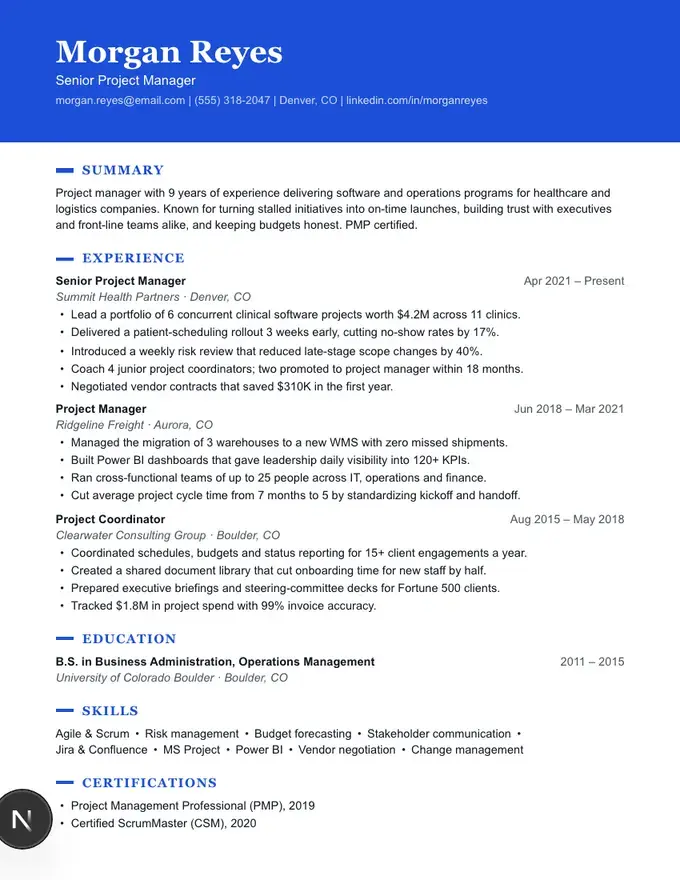
Banner resume template
Color header, one column
Healthcare
These medical assistant sample resumes split the job the way clinics do: clinical work (rooming, vitals, injections, EKGs, blood draws) and administrative work (scheduling, insurance checks, prior authorizations, the EHR). The main example is a certified medical assistant in family medicine who started at a dermatology front desk.
Below are bullets for both sides of the job, the credentials employers recognize with their real issuers, and what to change for pediatrics, dermatology and orthopedics. Numbers inside the example bullets are placeholders for your own.
The example opens as a new resume you can edit. Free to build and preview; downloads are a one-time payment, no subscription.
The person and employers in this sample are fictional, and its numbers are placeholders to replace with your own.
Rooming speed decides whether a provider runs on time, so the number of patients you room per day is the first figure a practice manager looks for.
List each procedure you are trained and permitted to do. What a medical assistant may perform depends on state rules and the supervising provider, so be exact.
In smaller practices the MA covers the front desk too. Show you can keep a schedule full and the money side clean.
Back-office work is invisible until it stalls. Turnaround numbers show you keep patients moving between visits.
Clean rooms, logged sterilization and full supply shelves are inspected, so they are worth a bullet when you owned them.
| Credential | Issued by | Notes |
|---|---|---|
| CMA (AAMA), Certified Medical Assistant | American Association of Medical Assistants (AAMA) | The usual route to the exam is a medical assisting program accredited by CAAHEP or ABHES. The credential stays current for 60 months; recertify by continuing education or by retaking the exam. |
| RMA (AMT), Registered Medical Assistant | American Medical Technologists (AMT) | Covers clinical and administrative duties. Write "RMA (AMT)" so it is not confused with other medical assistant credentials. |
| CCMA, Certified Clinical Medical Assistant | National Healthcareer Association (NHA) | Clinical focus, renewed every two years with continuing education. |
| NCMA, National Certified Medical Assistant | National Center for Competency Testing (NCCT) | Covers clinical and administrative tasks. |
| BLS Provider | American Heart Association | Many clinics ask for it. Add the expiration month. |
| CPT (Certified Phlebotomy Technician) or CET (Certified EKG Technician) | National Healthcareer Association (NHA) | Optional add-ons that back up the blood draw and EKG bullets. List them after your main medical assistant credential. |
| What is measured | How to phrase it |
|---|---|
| Patients roomed per day | "Roomed an average of 30 patients a day across two providers." Add the provider count, because 30 for one physician is a different pace than 30 for three. |
| Rooming time | "Cut average rooming time from 9 to 6 minutes by pre-charting the next day's visits." |
| Blood draw success | "First-stick venipuncture success above 95% across roughly 4,000 draws." Only use a rate your clinic actually tracked. |
| Prior authorization turnaround | "Brought average prior authorization turnaround from 5 business days to 2." |
| Care gaps closed | "Closed care gaps for 300 patients with diabetes (A1c draws, eye exam referrals) before the practice's quality reporting deadline." |
| No-show rate | "Lowered the no-show rate from 14% to 8% with day-before reminder calls and a same-day waitlist." |
Recent graduate of an accredited medical assistant program with a 160-hour externship in internal medicine, current BLS, and the CMA (AAMA) exam scheduled for next month. Comfortable rooming patients, drawing blood and charting in Epic.
Certified medical assistant with 4 years in a busy family medicine practice, rooming about 30 patients a day for two physicians. Handles injections, EKGs and venipuncture, plus prior authorizations and the refill queue in athenahealth.
Lead medical assistant in a 6-provider orthopedic clinic. Trains new MAs, builds the daily rooming plan, sets up joint injection trays and manages imaging and brace prior authorizations.
Many clinics prefer or require a national credential, so it sits right under the summary. Labeling skills as clinical or administrative lets a practice hiring for the back office and one hiring for front desk coverage both find their match quickly. Education goes last once you have a year of clinic work; before that, move it above experience so the externship hours do the work a job would.
Many do. Requirements come from states and individual employers rather than one national rule, and plenty of postings ask for a national credential such as CMA (AAMA), RMA (AMT), CCMA (NHA) or NCMA (NCCT). If you are not certified yet, list your program, externship hours and the date you are scheduled to test.
The one the posting names. If it names none, put your main medical assistant credential first, then BLS, then add-ons such as phlebotomy or EKG certification.
Use a typical range and the provider count: "Roomed 25 to 35 patients a day for 2 physicians." A range is honest and still shows your pace. If you floated between sites, say how many.
One page, one column, most recent job first. Clinics and health systems often take applications through an online system, and a single column with plain headings keeps your credentials and jobs in order when the file is parsed.
Yes. Give it its own entry titled "Medical Assistant Extern" with the clinic, dates and hours, and two or three bullets on what you did. Keep the title honest so a reference check matches what you wrote.
Open it in the builder, replace the details with your own and watch the page update as you type.
Color header, one column
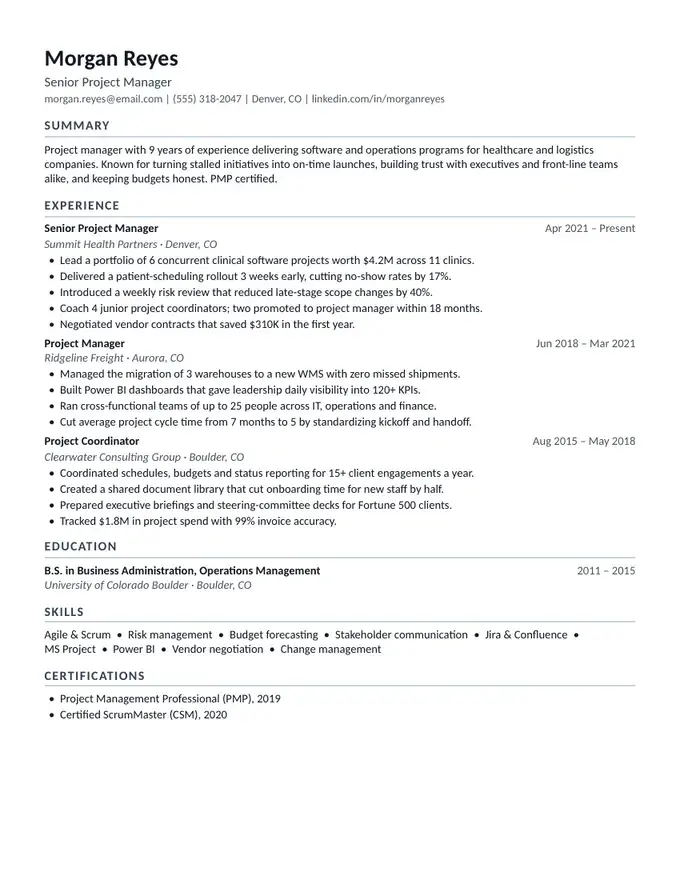
Simple and compact
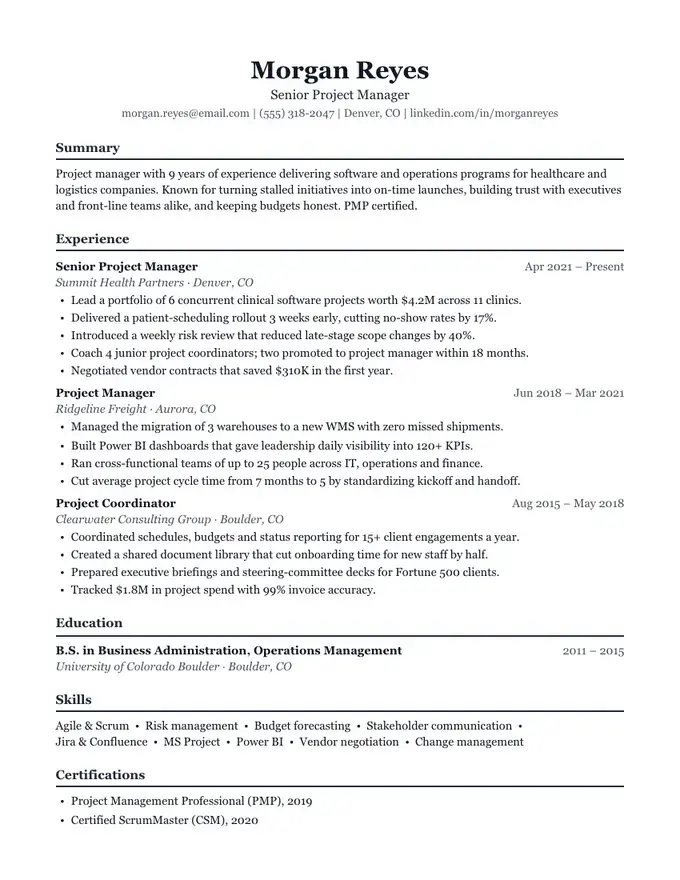
Classic and centered