 ResumeFinch
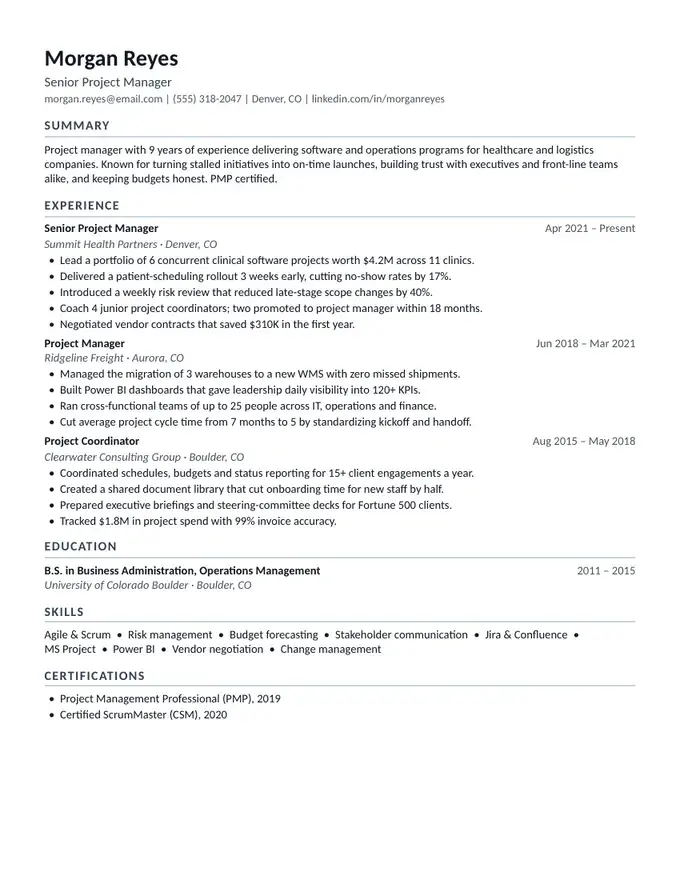
Slate resume template
Simple and compact
Software engineers
A strong software engineer resume is one column, usually one page, with experience (or projects, early on) near the top and bullets that name the system, the stack and a measured result. The template here is Keystone, a dense layout built for engineering resumes, shown with a fictional senior backend engineer's resume you can open in the builder and rewrite as your own.
Below the preview you will find example bullets for each career level, rules for when projects should outrank jobs, section orders by stage, and a note on software engineer CVs. If you came looking for the LaTeX layout Keystone is modeled on, the Jake's Resume page compares the two.
Free to build and preview. Downloads are a one-time payment, no subscription.
The first read of an engineering resume is fast, and it is mostly a search for evidence that you have built things that run in production. Bullets that describe duties ("responsible for backend services") give a reviewer nothing to find. Bullets that name what you built, what it ran on and what changed afterwards answer the questions before they are asked.
What a bullet has to prove changes as you move up. The examples are fictional and their numbers are placeholders; use your own figures, or describe the change in words when you cannot share one.
| Level | What the bullet has to prove | Example bullet |
|---|---|---|
| New grad (internship) | You shipped code into a real team's codebase | Added retry handling to the order-sync job in TypeScript during a summer internship, ending a daily manual rerun by the support team. |
| New grad (project) | You finished something and someone used it | Built a study-room booking site in Django for a 2,000-member student union, replacing a shared spreadsheet. |
| Mid-level (feature) | You own work from spec to launch | Owned the saved-search feature from spec to launch in Kotlin and Postgres; it now accounts for 15% of weekly sessions. |
| Mid-level (reliability) | Your code holds up in production | Cut the nightly ETL failure rate from 1 in 5 runs to 1 in 60 by adding schema checks and idempotent writes. |
| Senior (direction) | You set technical direction others adopt | Wrote and drove the design for queue-based search indexing, adopted by 3 teams and cutting index lag from hours to under a minute. |
| Senior (people) | You make the engineers around you better | Started the frontend review rotation and mentored 4 engineers, 2 of whom now lead their own projects. |
A senior resume that only has mid-level bullets reads as mid-level, however many years it covers. If most of your bullets are about features you built alone, add the design decisions, migrations and mentoring that a senior role expects, provided they happened.
Paid work almost always outranks projects, because it shows code that other people relied on. Projects earn a place above experience in three situations: you are a student or new graduate without an internship, you are moving into software from another career or a bootcamp, or a project is clearly more advanced than your current job.
A project is worth listing when it is deployed or published, has users or contributors other than you, or solved a hard problem you can talk about for ten minutes. Tutorial clones and course assignments everyone in your class built rarely help. Merged contributions to an established open-source project count as experience in all but name; list them with the project name and what the change did.
Freelance and contract work goes under Experience as a normal entry with your own business name or "Independent contractor", not under Projects. In ResumeFinch, projects live in a custom section added from the Projects preset, one item per project, and you can drag that section above or below Experience as your career changes.
| Stage | Section order | Why |
|---|---|---|
| Student or new graduate | Education, Experience, Projects, Skills | The degree and coursework are your most recent full-time commitment. |
| Career changer or bootcamp graduate | Summary, Projects, Skills, Experience, Education | The summary explains the switch, and projects carry the technical evidence. |
| One to six years | Summary (optional), Experience, Skills, Projects, Education | Jobs now prove more than projects; keep one or two projects only if they add something. |
| Senior and staff | Summary, Experience, Skills, Open source or talks, Education | Scope and direction lead; education shrinks to one line. |
List what you could be interviewed on tomorrow. A long list of every language you touched once makes reviewers doubt the ones that matter, and a skills section without the posting's main language or cloud provider makes them wonder whether you missed it. Match the posting's spelling ("PostgreSQL" or "Postgres") when you have the skill.
Skip office software, operating systems you use as a consumer, and self-rated proficiency levels. Group related items, either as separate entries (as in the sample) or as labeled groups like "Languages: Go, Python, SQL" if you prefer the Jake's Resume style.
In the US and Canada, a software engineer CV and a software engineer resume are the same document: one or two pages of work history, skills and education. Outside North America, "CV" is the everyday word for that same document, so a posting asking for a CV from a developer usually wants exactly what this page describes. A long academic CV with publications is only expected for research scientist and faculty roles.
ResumeFinch pages are US Letter size only, with no A4 option. A Letter PDF reads normally on screen anywhere; a reviewer printing it on A4 paper may need the printer's fit-to-page setting. Keystone's 10 pt text stays legible if the page is scaled down slightly to fit.
Include it when the profile shows work you would discuss in an interview: pinned repositories with READMEs, real commit history or merged contributions. An empty or coursework-only profile is better left off. Put the link in the website field so it prints in the contact line.
Two or three for a student or career changer, each with its stack and one line about users or outcome. With a few years of paid work, one project or none is normal, unless it shows something your jobs do not, such as a widely used open-source library.
No. List the languages you could write in an interview without preparation, then the frameworks and infrastructure you used in the last few years. A language you have not touched since school can go, unless the posting asks for it and you can refresh quickly.
Add each title as its own experience entry with its own dates, newest first, and keep the company name identical on both so the promotion is obvious. ResumeFinch does not merge entries for the same employer, so the two entries simply sit one after the other.
For experienced engineers and career changers, yes: two or three sentences that state level, specialty and the kind of systems you build. New graduates can usually skip it, since education and projects already say what a summary would.
Start with Keystone. You can switch templates anytime.
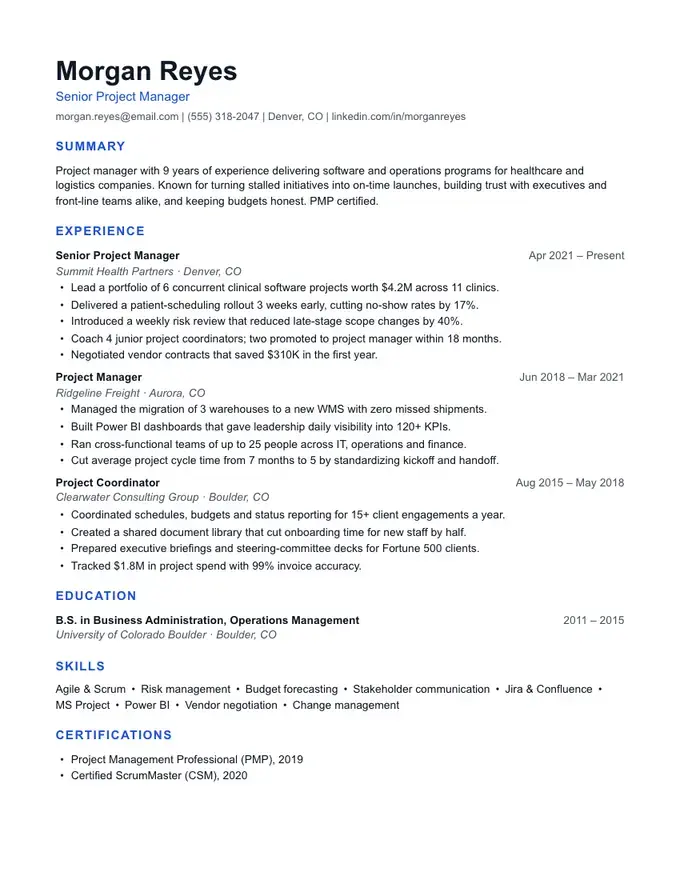
Simple and compact
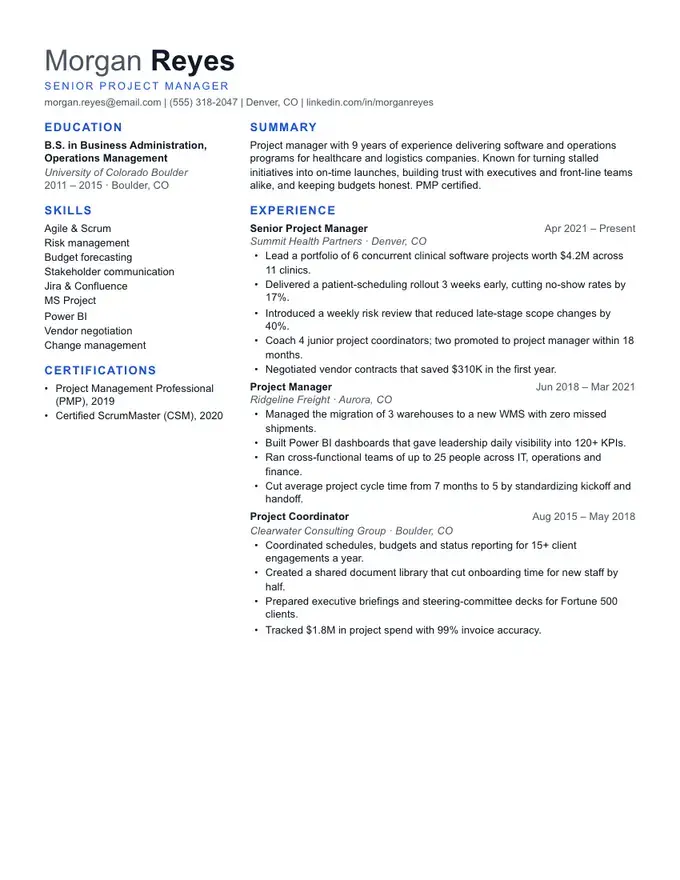
Two columns, content-rich
Modern with a blue accent
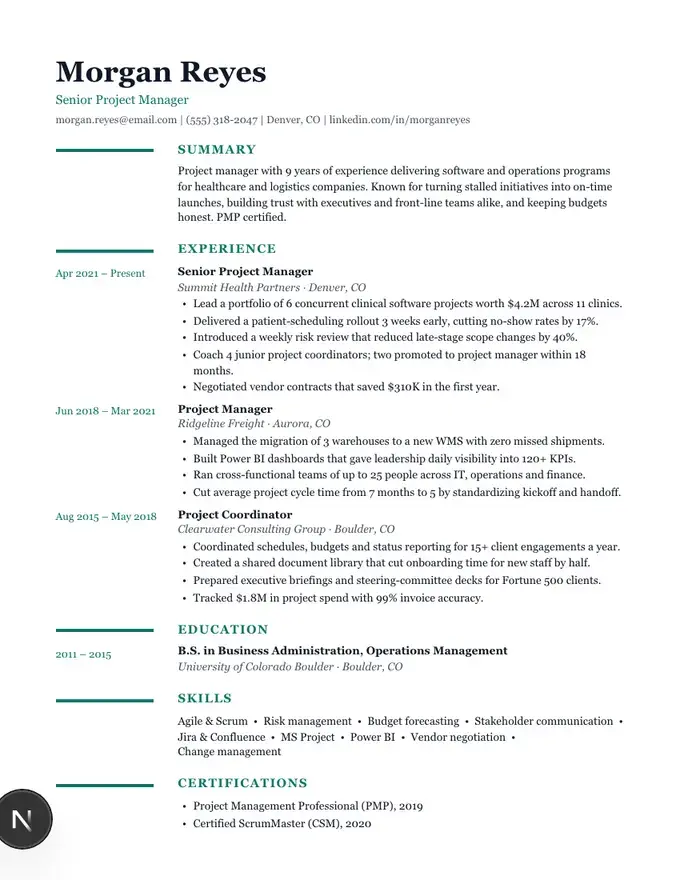
Dates in the margin